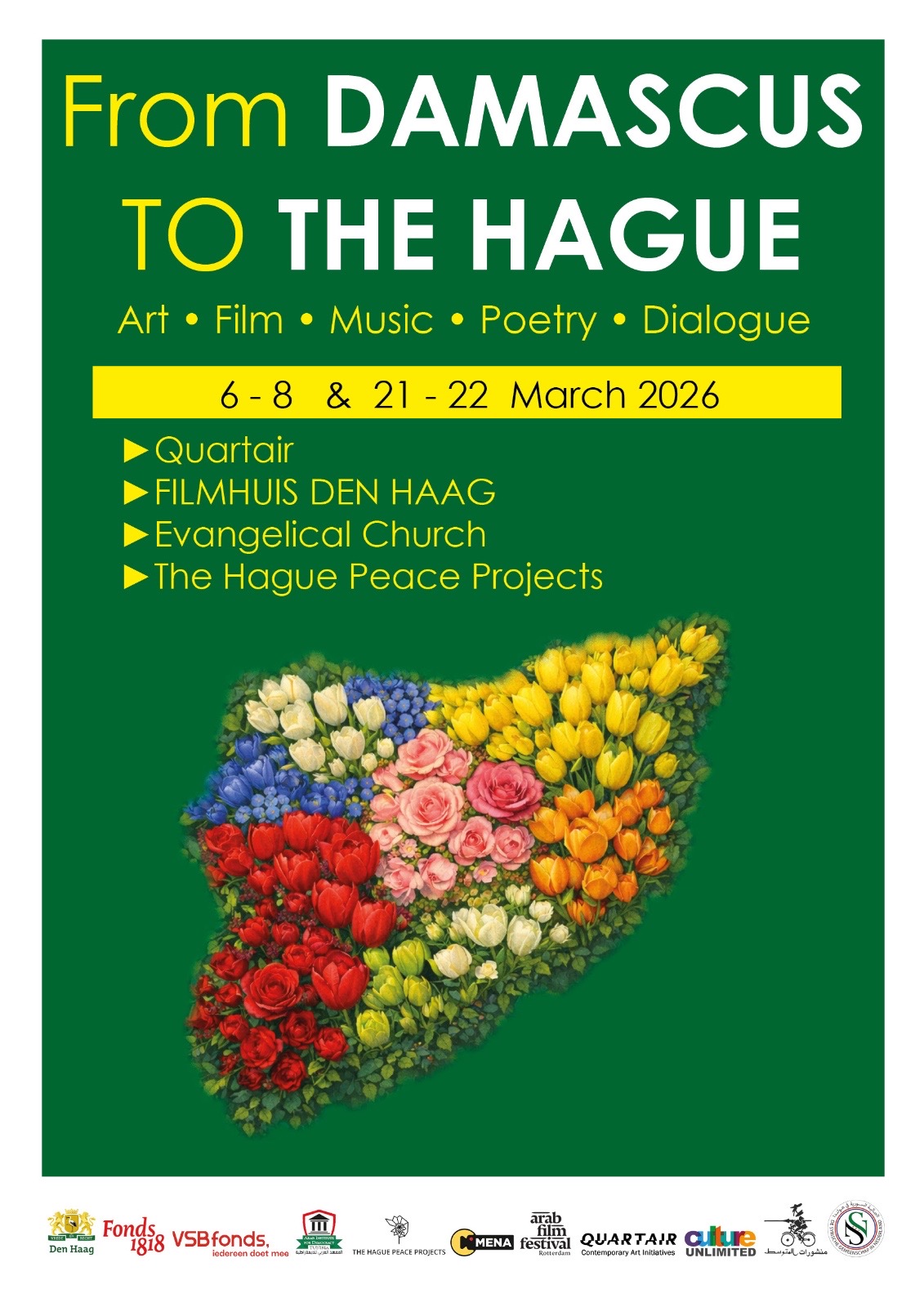
Global Music Lab, Music, Poetry, and visual art
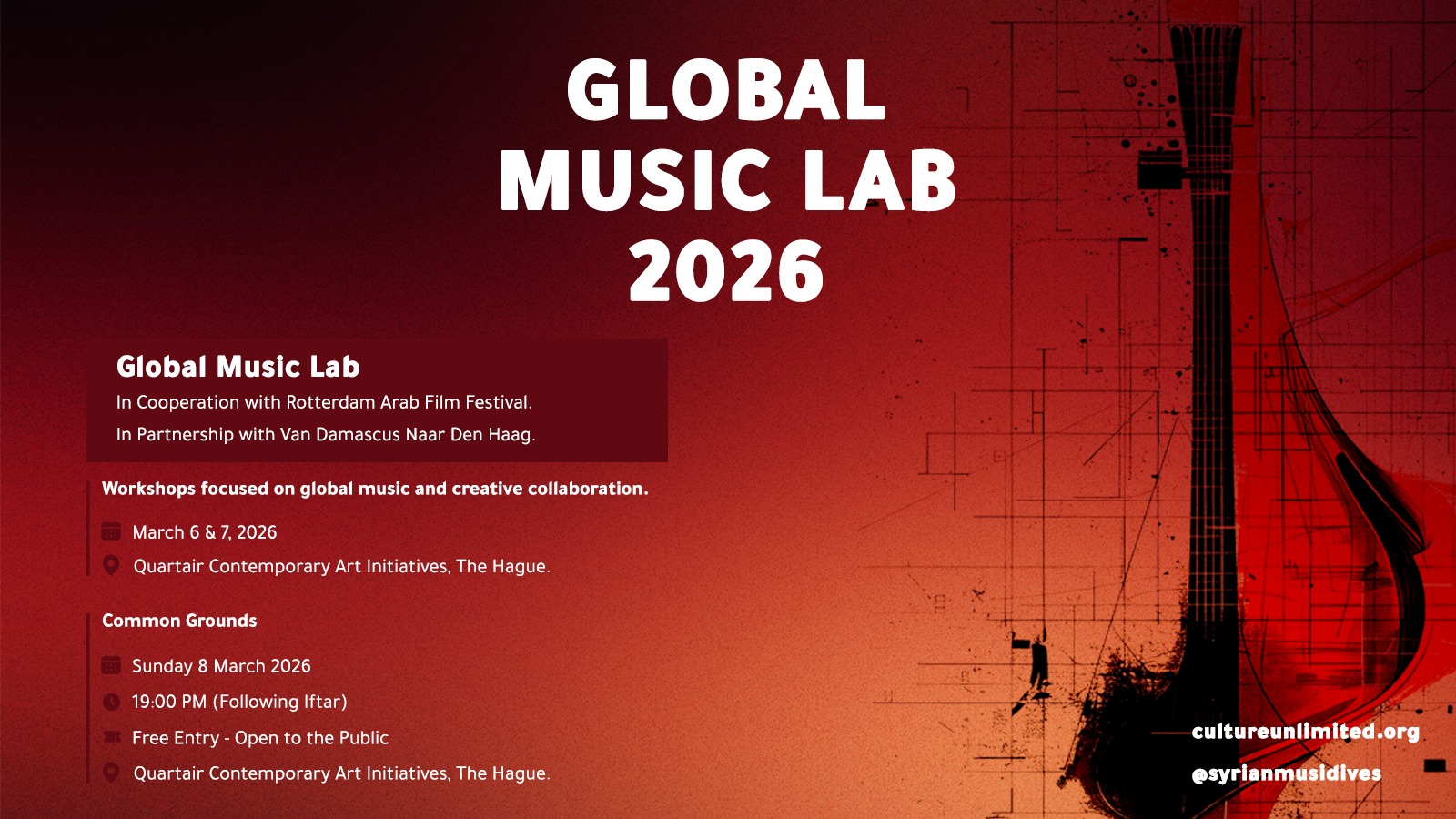
Global Music Lab
A day of music, poetry, and visual art.
Music Connection Lab 2026
Quartair Contemporary Art Initiatives
Toussaintkade 55
2513 CL Den Haag
📅 Sunday 8 March 2026
🕖 19:00 (following iftar)
🎟 Free entry – open to the public
In collaboration with Rotterdam Arab Film Festival
In partnership with Van Damascus naar Den Haag
About the Global Music Lab
The Global Music Lab is part of Music Connection Lab 2026 and brings together musicians connected to The Hague for an intensive process of musical collaboration, exchange, and collective creation.
Running in parallel, the partner programme Van Damascus naar Den Haag organises a three-day interdisciplinary workshop with Syrian artists and participants with a Syrian background, focusing on visual art, video art, and painting.
The two programmes intersect during the public presentation on 8 March, while maintaining their own artistic focus and autonomy.
Workshops
The music workshops of the Global Music Lab focus on collaborative music-making and experimentation across genres and traditions. Musicians work together to develop new material and performance formats in response to the shared context of the exhibition and public presentation.
Dates: 6 & 7 March 2026
Location: Quartair Contemporary Art Initiatives, The Hague
At the same time, within the framework of Van Damascus naar Den Haag, participants collaborate on a collective installation around the theme of just transition (rechtvaardige transitie).
This interdisciplinary process is informed by poetry, short films, group conversations, and moments of reflection.
Concert & Public Presentation
On Sunday 8 March 2026, the outcomes of both trajectories come together in a public moment.
Following the iftar, at 19:00, the exhibition opens and is accompanied by live music and performances developed within the Global Music Lab. The evening creates a shared space where music, visual art, and dialogue meet, while clearly reflecting the distinct artistic contributions of each programme.
Date & time: 8 March 2026 — 19:00
Location: Quartair Contemporary Art Initiatives, The Hague
Entry: Free
Music Participants
(Global Music Lab – confirmed so far)
- Guido Langranchi — cajón, vocals
- Pepe Herpen — vocals, guitar, harmonica
- Jules van de Port — saxophone
- Christo Wijnroks — accordion
- Kourosh Jdadi — saxophone, bass guitar, or drum set (flexible)
- Ayman Sandouk — synthesizer
- Alex Hadeed — guitar, oud, bass, percussion
- Anan Al-Kadamani — violin
- Hannibal Saad — guitar
- Alejandra Gomez — hula hoop dancer (performance artist)
- Jonatan Weenink- sax
Guest musician:
- Amel Sdiri — vocals
As part of the Global Music Lab within Culture Unlimited Festival, Lukman Derky contributes as a poet and spoken-word artist, bringing his distinctive voice into direct dialogue with musicians from diverse cultural and musical backgrounds. In this collaborative setting, his texts become living material — interacting with improvisation, rhythm, maqam, contemporary composition, and experimental sound. Rather than a traditional poetry reading, his participation unfolds as an interdisciplinary encounter where word and music evolve together in real time. Through irony, memory, and political sensitivity, Derky’s presence adds a powerful literary dimension to the lab’s exploration of migration, identity, and shared cultural space.
Lukman Derky – Poet, Writer, Cultural Curator
Lukman Derky (b. 1966, Derbasiyah, Syria) is a Syrian poet, writer, cultural organizer, and media personality whose work has played a significant role in shaping contemporary Syrian literary expression. Emerging in the 1980s as part of a new generation of Syrian poets, he became widely recognized for his distinct poetic voice that combines black irony, political critique, existential reflection, and an intimate engagement with everyday life.
Derky first gained attention through his participation in the literary forum at the University of Aleppo, where his writing stood out for its bold tone and unconventional imagery. Since the mid-1980s, he has published extensively in Syrian and Arab newspapers and magazines, establishing himself as a prominent cultural commentator and creative voice.
He is co-founder of the literary magazine Alif (1990), dedicated to new writing and experimental literary expression, and co-founder of the satirical newspaper Al-Domari (2001), one of Syria’s most notable independent satirical publications. His engagement with satire and cultural criticism positioned him at the forefront of intellectual debate in Syria during the late 1990s and early 2000s.
Derky has published six poetry collections and two short story collections. In addition to his literary books, he has written numerous journalistic and cultural essays in leading Arab newspapers. From 2007 until April 2011, he wrote a daily column for the Syrian newspaper Baladna. In the same period, he contributed a weekly satirical column to Qasyoun, focusing on Kurdish affairs in Syria, offering commentary that combined humor with sharp socio-political insight.
Between 2007 and 21 March 2011, Derky founded and curated the weekly cultural evening “Beit Al-Qasid” (House of the Poem) at Jackson Bar, Firdaws Tower Hotel in Damascus. This open poetic and musical platform became a unique interdisciplinary gathering where poets and musicians from around the world performed in more than thirty languages. The event, lasting four to five hours each week, created a rare free space for artistic expression in Syria, welcoming professionals and amateurs alike. Poetry was presented in classical Arabic as well as in regional dialects, reflecting cultural diversity and creative openness.
Following the outbreak of the Syrian revolution on 15 March 2011, the atmosphere of “Beit Al-Qasid” transformed into a space resonating with the voice of the uprising. Poetry and music began to directly express the unfolding political and social reality. The final evening of the platform took place on 21 March 2011, marking the end of an important independent cultural forum in Damascus.
Beyond poetry and journalism, Derky has worked across multiple fields of dramatic art, including theatre, television, and cinema, as an author, actor, director, and presenter. His multidisciplinary practice reflects his belief in the interconnectedness of artistic forms and public discourse.
After 2011, Derky openly adopted an oppositional stance toward the Syrian regime. He left Syria in late 2012 and settled in Europe. Since 2014, he has been based in France, where he continues to write, publish, and participate in cultural and literary events. In exile, his work increasingly engages with themes of displacement, memory, freedom, identity, and the psychological landscape of political rupture. His writing maintains its characteristic irony and emotional depth while reflecting the transformations of exile and diaspora.
Today, Lukman Derky remains an influential figure in contemporary Arabic literature, bridging poetry, satire, performance, and cultural activism, and continuing to engage audiences across Europe and the Arab world
We are happy to co produce many events with Roterdam Arab Film Festival is this project in this project and other Project.